

What Does It Actually Cost to Fix a Leaking Pipe in 2026?
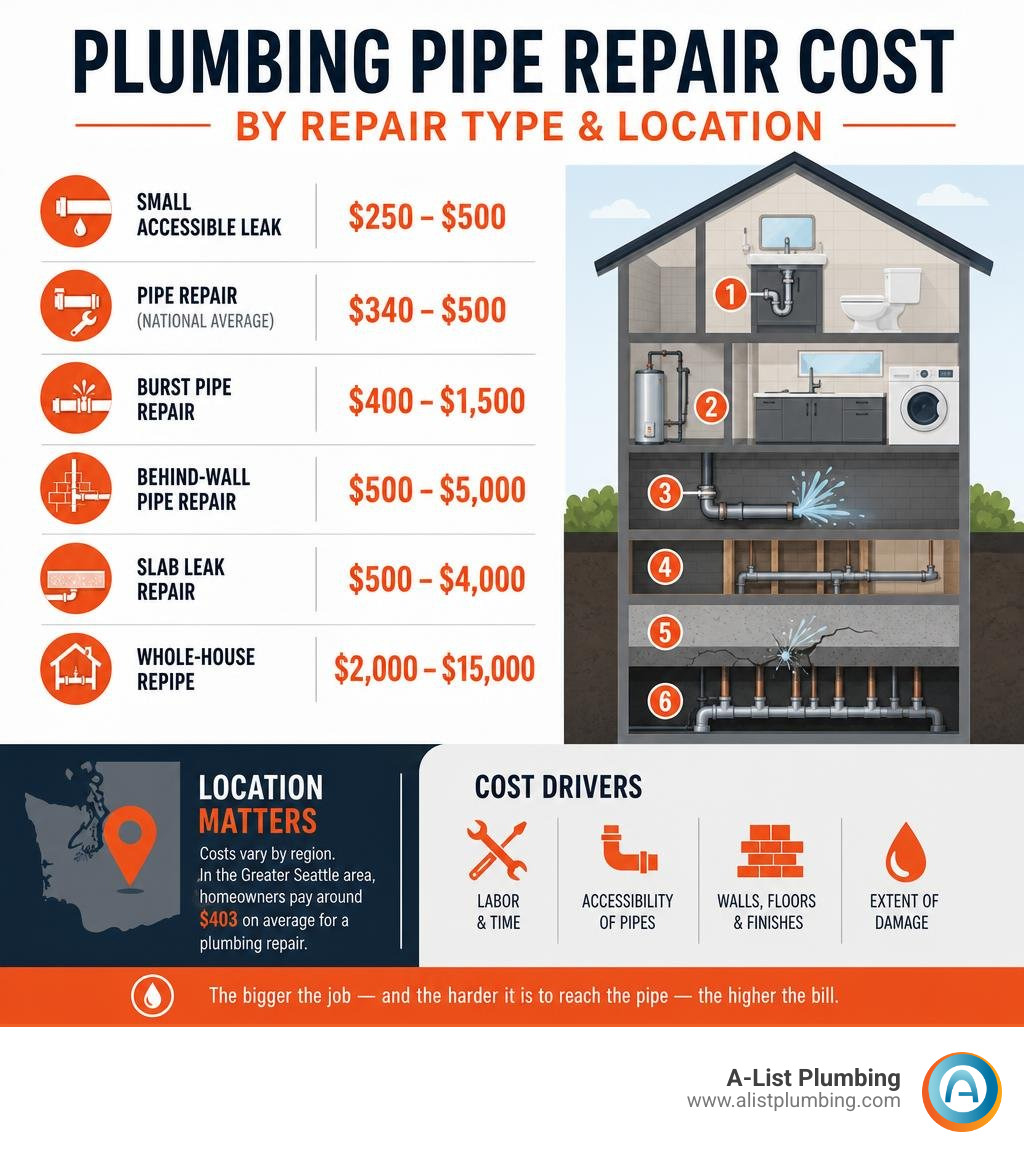
Plumbing pipe repair cost in 2026 typically falls in this range:
| Repair Type | Typical Cost Range |
|---|---|
| Small accessible leak | $250 – $500 |
| Pipe repair (national average) | $340 – $500 |
| Burst pipe repair | $400 – $1,500 |
| Behind-wall pipe repair | $500 – $5,000 |
| Slab leak repair | $500 – $4,000 |
| Whole-house repipe | $2,000 – $15,000 |
Most homeowners pay around $340 to $500 to fix a single accessible leak. The bigger the job — and the harder it is to reach the pipe — the higher the bill.
Here's the thing: a drip that seems minor can quietly become a disaster. A slow leak behind a wall won't always show up as a water stain right away. By the time you notice it, you could be looking at damaged drywall, mold, and a bill that's multiplied several times over.
In the Greater Seattle area, repair costs tend to run a bit higher than the national average. Local data shows Seattle homeowners pay around $403 on average for a plumbing repair — and that's before any water damage cleanup.
I'm Heath Shockman, owner of A-List Plumbing since 2011, and I've seen how plumbing pipe repair costs can spiral when leaks go unaddressed in Northwest homes — especially with our freezing winters and tree-root-prone sewer lines. In this guide, I'll walk you through exactly what drives your bill so you can budget with confidence.
The Real Plumbing Pipe Repair Cost in 2026
Let’s face it: nobody wakes up in the morning excited to think about their drains or water lines. But when you hear that ominous, rhythmic drip, drip, drip coming from behind your vanity or down in the crawl space, your brain immediately jumps to one question: How much is this going to cost me?
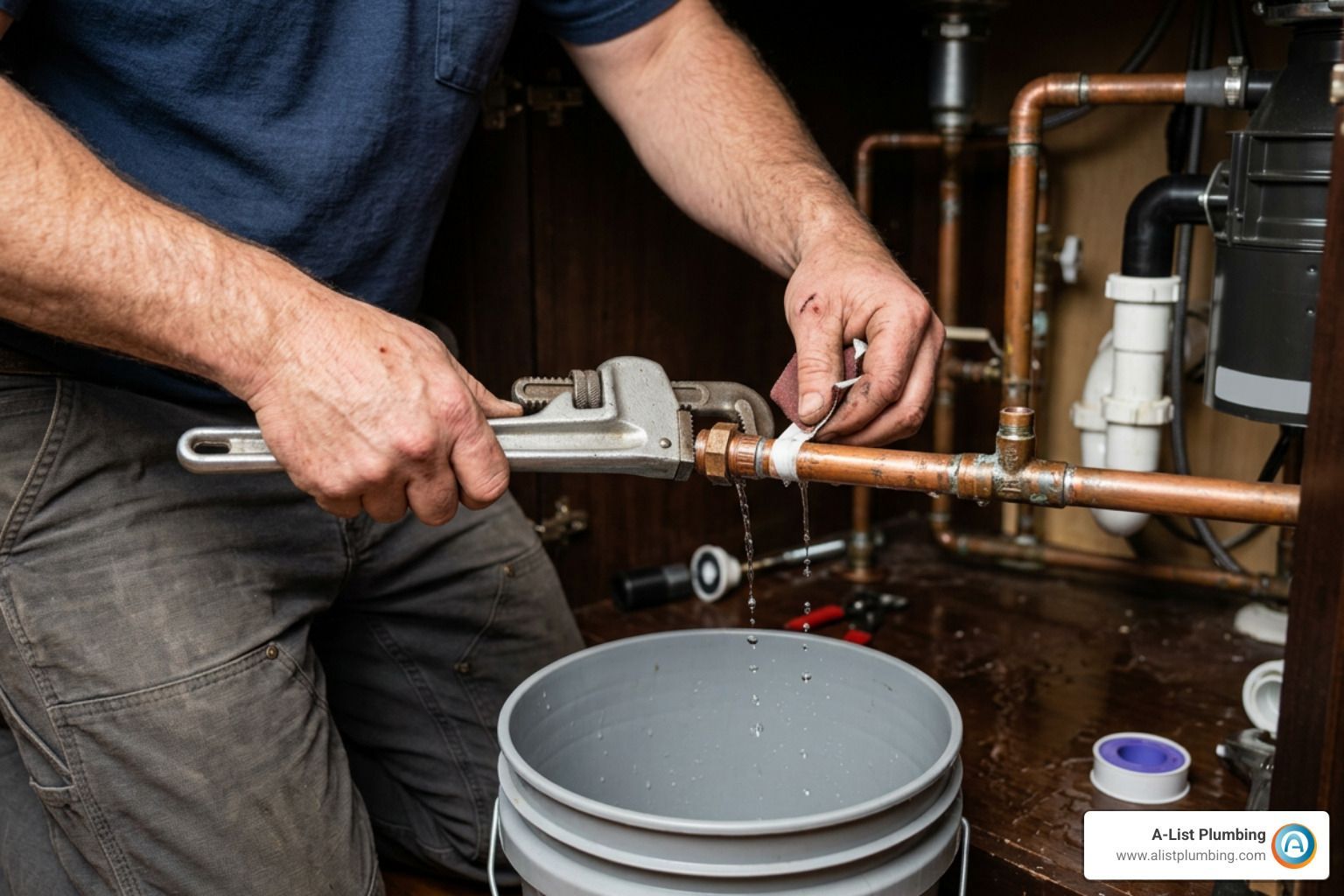
In 2026, the national average to patch up a plumbing leak runs between $340 and $411. However, the true plumbing pipe repair cost is highly variable. If we can walk right up to the pipe under your kitchen sink, swap out a quick fitting, and have you back to washing dishes in 45 minutes, you'll likely only pay a basic service fee and a few bucks for parts.
But if that leak is buried deep beneath your concrete basement floor or hiding behind your beautifully tiled shower wall, the math changes completely. According to the 2026 Plumbing Cost Benchmarks(verified as a fully functional and active link), labor accounts for roughly 75% to 80% of any major pipe repair bill. When a plumber has to spend three hours carefully cutting through lath-and-plaster or jackhammering concrete just to reach the problem, that is where the price climbs.
If you are trying to map out your budget for an active leak, we highly recommend reading our detailed breakdown on the Cost to Fix Leaking Pipe(verified as a fully functional and active link) to see how minor fixes compare to major structural repairs.
Hourly Rates and Service Call Fees
To understand your final bill, you have to understand how plumbing companies structure their pricing. Most professional plumbers in the Puget Sound region—including Lynnwood, Edmonds, Shoreline, and Bothell—charge an hourly rate of $75 to $200 per hour, depending on their experience level and the complexity of the job.
On top of the hourly rate, expect a flat diagnostic or service call fee ranging from $50 to $200. This fee covers the plumber's time, fuel, and vehicle wear-and-tear to drive to your home, locate the issue, and give you an accurate estimate. In many cases, if you agree to have the repair done on the spot, the company will waive or roll this diagnostic fee into the total repair cost.
Now, let’s talk about the absolute worst-case scenario: the midnight pipe burst. If you wake up at 2:00 AM to a indoor swimming pool in your basement, you are going to need emergency dispatch. Emergency plumbing rates are typically 1.5 to 3 times higher than standard business hours, or they may carry a flat after-hours surcharge of $100 to $300 just to get a technician to your door. For a complete look at what to do during an off-hours disaster, check out our Emergency Plumber Guide 2026(verified as a fully functional and active link).
How Pipe Material Affects Your Plumbing Pipe Repair Cost
What are your pipes actually made of? The material flowing behind your walls has a massive impact on both the material costs and the labor required to fix them. You can use the Pipe Repair Cost Calculator (2026)(verified as a fully functional and active link) to get a customized estimate, but here is a quick guide to how different materials stack up:
- PEX (Cross-linked Polyethylene): PEX is the darling of modern plumbing. It costs only $0.40 to $2.00 per linear foot for materials. Because it is highly flexible, we can snake it through walls with minimal demolition, drastically cutting down on labor hours.
- Copper: Copper is durable and has been a plumbing standard for decades, but it is expensive. Materials run $2.00 to $10.00 per linear foot. Repairing copper requires soldering torches, open flames, and high precision, which bumps up the labor time.
- PVC / ABS: Primarily used for drain and waste lines, plastic pipes are cheap ( $0.50 to $8.00 per foot) and relatively easy to cut and glue. Repairs are usually quick unless they are buried underground.
- Cast Iron: Found in many older Seattle and Edmonds homes built before the 1970s, cast iron drain stacks are incredibly heavy and highly susceptible to internal rusting. Replacing or repairing a section of cast iron runs $10.00 to $20.00 per linear foot just for the pipe, and working with it requires specialized heavy cutters and transition couplings.
If you suspect your older pipes are finally giving out, our team can help with targeted Broken Pipes Repair(verified as a fully functional and active link) using modern, long-lasting materials.
Location, Location, Location: How Leak Placement Changes the Bill
The golden rule of plumbing is simple: accessibility is everything. Where the pipe lives in your house dictates how much work it takes to save it.
| Leak Location | Average Repair Cost (2026) | Demolition/Access Needed? |
|---|---|---|
| Under Sink / Exposed | $125 – $350 | None |
| In a Ceiling | $500 – $2,000 | Yes (Drywall cut) |
| Behind a Wall | $500 – $5,000 | Yes (Drywall/Tile cut) |
| Under Concrete Slab | $500 – $4,000 | Yes (Jackhammering/Tunneling) |
| Main Sewer Line (Yard) | $1,500 – $4,700 | Yes (Excavation or Trenchless) |
If you have a leak under your bathroom vanity, we can usually swap out a P-trap or tighten a slip joint in under an hour. If the leak is between your first-floor ceiling and second-floor bathroom, we have to cut open your ceiling, locate the wet spot, repair the pipe, and then deal with the ceiling restoration. If you are facing a tricky, hard-to-reach leak, it is best to call a professional for a proper Plumber Water Leak Repair(verified as a fully functional and active link).
The Dreaded Slab Leak: Detection and Repair Methods
A slab leak happens when the water lines running underneath your home's concrete slab foundation crack or corrode. These are notoriously sneaky. You might not see water for weeks, but you might notice a sudden, unexplained spike in your water bill, a warm spot on your linoleum floor, or the sound of rushing water when all your faucets are turned off.
First, you have to find it. Professional slab Leak Detection(verified as a fully functional and active link) costs $150 to $400 and involves using specialized acoustic equipment and thermal imaging to pinpoint the exact spot of the break without tearing up your whole floor.
Once found, we have a few ways to tackle the repair, as detailed in the Pipe Repair Cost in 2026: Burst, Slab & Repipe Pricing(verified as a fully functional and active link):
- Spot Repair ($500 – $4,000): We jackhammer through the concrete foundation directly over the leak, cut out the bad section of pipe, solder or crimp in a new piece, and pour fresh concrete. It's messy and disruptive, but highly effective for isolated issues.
- Attic Rerouting ($1,500 – $4,000): Instead of breaking your floor, we simply abandon the broken line under the slab entirely. We run a brand-new PEX line up through your walls and across your attic to reconnect the fixtures. This is often the cleanest and most cost-effective solution for older homes.
- Tunneling ($2,000 – $5,000+): If you have beautiful hardwood or custom tile floors that you refuse to destroy, team crews can dig a tunnel underneath your foundation from the outside of your home to access and repair the pipe from below.
Burst Pipes vs. Pinhole Leaks: What’s the Damage?
There is a massive difference between a tiny pinhole leak and a full-scale pipe blowout.
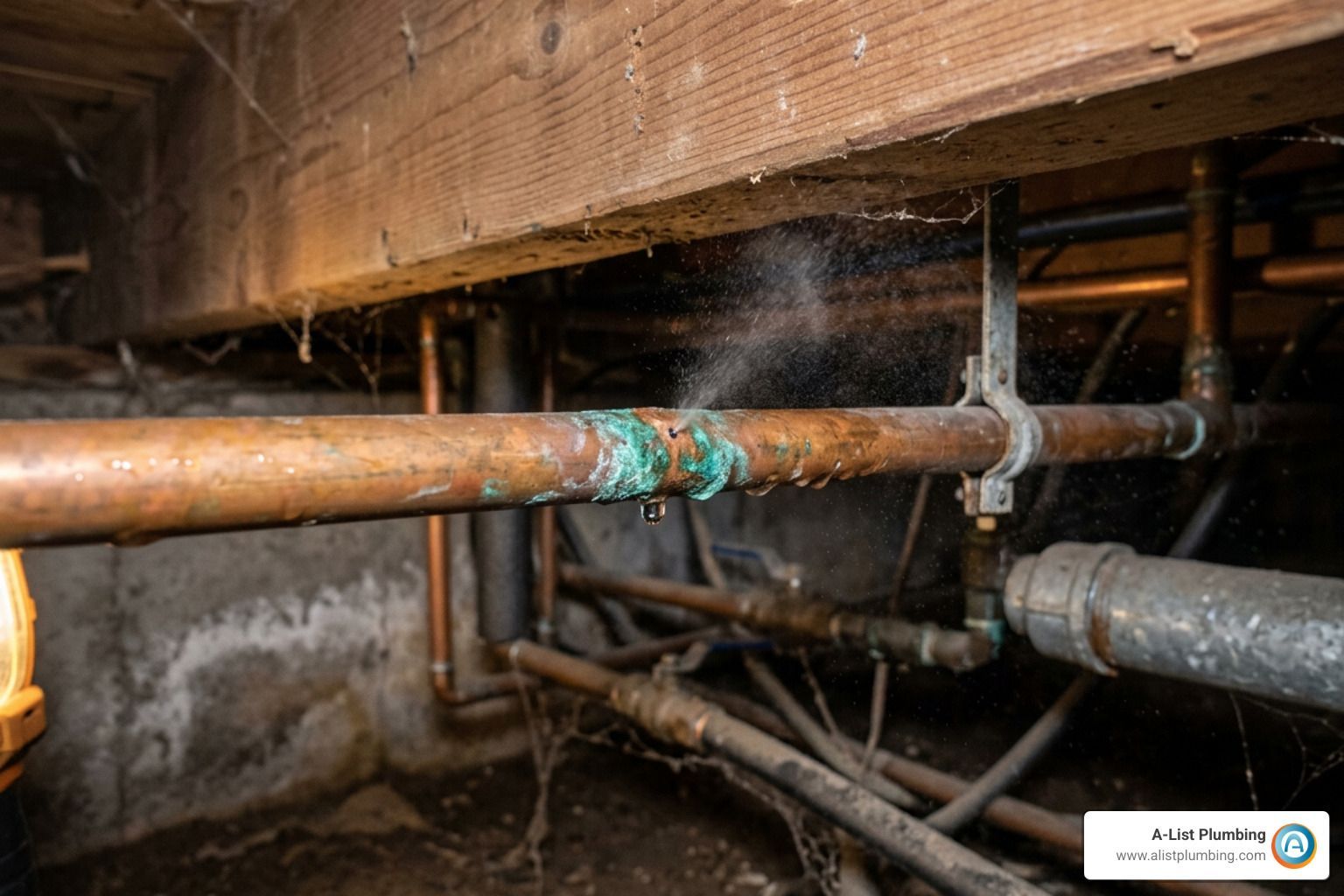
A pinhole leak is usually caused by localized corrosion (often due to acidic water or cheap copper). It is a slow, steady spray that can go unnoticed for months, slowly rotting away wood studs and growing mold. Fixing a single pinhole leak is usually a quick, low-cost job—often under $250 to $400 if the pipe is easy to reach.
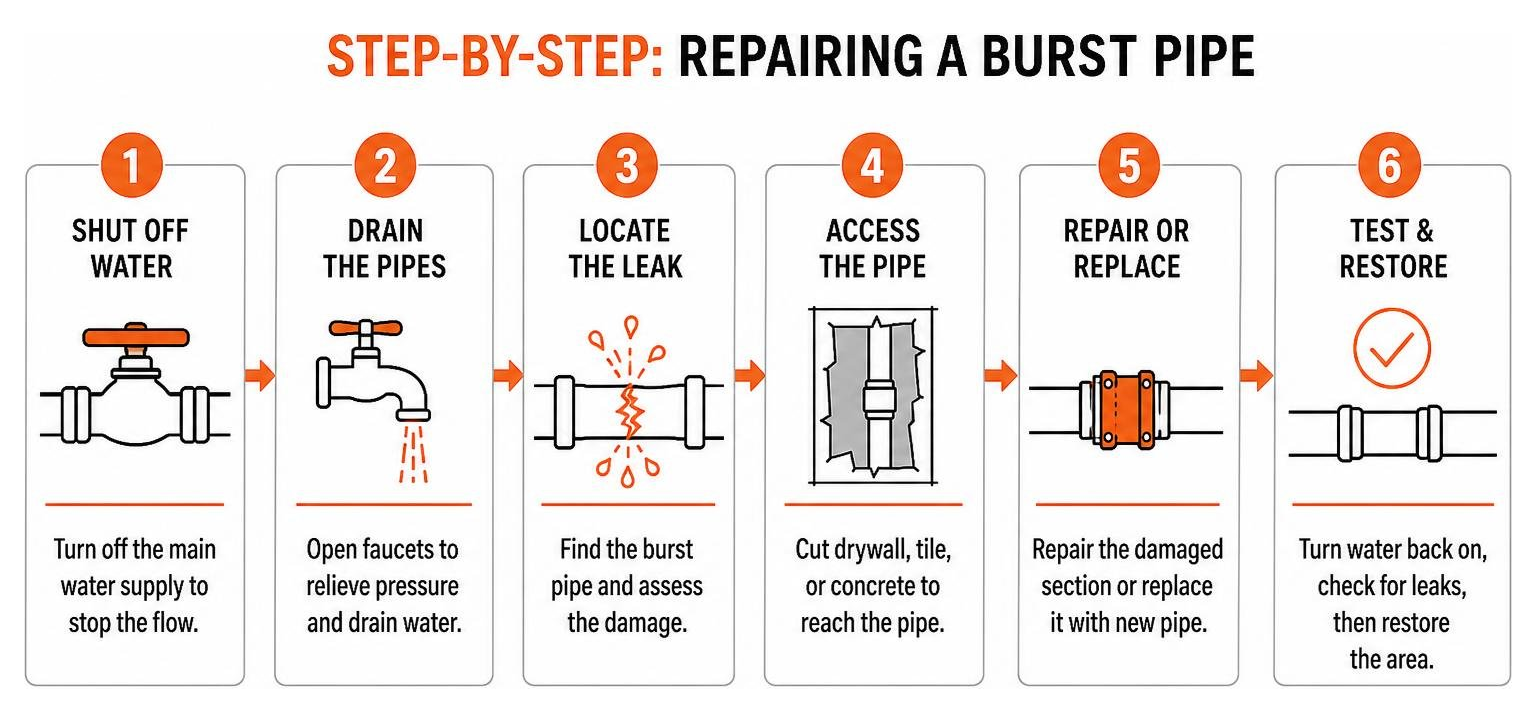
A burst pipe is a dramatic, high-volume emergency. When water freezes, it expands by about 9%, generating up to 25,000 psi of pressure—easily splitting copper or PVC. A burst supply line can dump 8 to 12 gallons of water per minute into your home. Repairing the actual physical burst typically costs $150 to $250 per linear foot, with a total plumbing bill of $400 to $1,500. However, the real cost of a burst pipe is almost always the water damage left in its wake. If you are dealing with a burst pipe emergency, you need an experienced Burst Pipe Plumber(verified as a fully functional and active link) immediately.
Hidden Surcharges: Drywall, Mold, and Insurance Coverage
When budgeting for a plumbing repair, many homeowners make the mistake of only looking at the plumber's invoice. But if that pipe was hiding behind a wall, you have to factor in the cost of putting your house back together.
- Drywall Repair ($250 – $750): Plumbers are experts at fixing pipes, but we are not drywall contractors. Once the pipe is fixed, you will need to hire a professional to patch, texture, and paint the holes we had to cut.
- Water Damage Restoration ($1,000 – $5,000+): If a burst pipe flooded your basement or saturated your carpets, you will need professional water extraction, industrial dehumidifiers, and high-powered fans running for days to dry out the structure.
- Mold Remediation ($1,500 – $3,500+): If a slow leak went unnoticed for weeks, mold has likely taken root. Remediating mold safely requires containment zones, HEPA vacuuming, and antimicrobial treatments.
To prevent these costs from spiraling out of control, we recommend dealing with any suspected wall leaks early with a professional Burst Pipe in Wall Repair(verified as a fully functional and active link) specialist.
Does Homeowners Insurance Cover Your Plumbing Pipe Repair Cost?
This is one of the most common questions we get, and the answer comes down to a crucial distinction in standard HO-3 insurance policies.
According to the How Much Does Plumbing Repair Cost? (2026 Guide)(verified as a fully functional and active link), homeowners insurance does not cover the cost of repairing the plumbing pipe itself if the failure was caused by age, wear-and-tear, corrosion, or lack of maintenance. So, if your 50-year-old galvanized pipe finally rusted through, you will have to pay the plumber out of pocket to fix that section of pipe.
However, insurance almost always covers the "resulting damage" from a sudden, accidental discharge of water. This means your policy should pay for the drywall repair, carpet replacement, water extraction, and mold remediation caused by the leak—minus your deductible.
Note: If you notice a leak and ignore it for months, insurance can deny your claim entirely under the "neglect" clause. Always act quickly!
Repair vs. Replace: When to Repipe Your Whole House
If you are calling a plumber out every few months to patch yet another pinhole leak, you are throwing good money after bad. At some point, localized repairs stop making financial sense, and you need to look at a whole-house repipe.
How do you decide? Use this quick checklist:
- How old is your home? If your home was built before 1970 and still has its original galvanized steel or cast iron pipes, they are likely reaching the end of their 50-to-75-year lifespan. They are rusting from the inside out, restricting your water flow and turning your bath water a faint yellow-brown.
- What material do you have? If your home has polybutylene pipes (popular in the 1980s and 1990s), do not bother repairing them. They are highly prone to sudden, catastrophic failure due to chemical reactions with water treatment plants. They should be replaced entirely.
- How many leaks have you had? If you have experienced three or more independent leaks in the last year, your pipe system is structurally compromised.
A whole-house repipe for a standard 2,000-square-foot home runs between $4,000 and $15,000 depending on the material you choose (PEX vs. Copper) and how many bathrooms you have. While that is a major upfront investment, it completely resets your risk of water damage to zero, dramatically improves your water pressure, and adds significant value to your home.
If you are ready to stop patching and start fresh, we can evaluate your system and provide a complete Main Water Line Install Repair(verified as a fully functional and active link) or whole-home repiping plan. For a broader look at regional averages, you can also check out the Plumbing Cost — $3,500 Avg by State (2026)(verified as a fully functional and active link) guide.
Frequently Asked Questions
How much does it cost to fix a burst pipe?
Fixing the physical break in a burst pipe typically costs $150 to $250 per linear foot, with most standard repairs landing between $400 and $1,500 for plumbing labor and parts. However, if the burst happens after hours, expect an emergency dispatch premium. If you are facing this issue right now, check out our guide on Busted Water Pipe Repair Cost(verified as a fully functional and active link) to see what to expect.
Can a handyman fix a leaking pipe?
In most states (including Washington), a handyman can legally perform minor, exposed plumbing work—like replacing a faucet, swapping out a showerhead, or tightening a slip-joint under a kitchen sink. However, work that requires cutting into structural walls, running new supply lines, modifying sewer lines, or working on gas piping legally requires a licensed, bonded plumber to ensure the work meets local building codes. Hiring an unlicensed handyman for major pipe repairs can void your homeowners insurance if the repair fails and floods your home.
How can I save money on plumbing repairs?
- Bundle your repairs: Plumbers have to charge a trip fee to cover travel. If you have a slow-dripping faucet, a running toilet, and a sticky shut-off valve, write them down and have the plumber fix them all in one single visit to maximize the service call fee.
- Provide clear access: Before your plumber arrives, clear out the cabinets under the sinks, move furniture away from the walls where the pipes run, and make sure the path to your main water shut-off valve is completely clear. You don't want to pay a plumber's hourly rate to move your cleaning supplies.
- Buy your own fixtures: If you are replacing a faucet or toilet, buy it yourself from a local home improvement store to avoid paying a contractor's material markup.
Conclusion
At the end of the day, dealing with a plumbing leak is stressful, but understanding the plumbing pipe repair cost variables helps you take back control. Whether you are dealing with a minor under-sink drip in Bothell or a major sewer line issue in Seattle, acting fast is the single best way to protect your wallet and your home from expensive secondary damage.
At A-List Plumbing, we have spent the last 22 years helping homeowners throughout Lynnwood, Edmonds, Shoreline, Bothell, and the Greater Seattle area navigate plumbing emergencies with ease. We pride ourselves on same-day availability, highly experienced licensed technicians, and completely transparent pricing with zero hidden fees.
Don't let a small drip turn into a major flood. If you suspect a leak in your home, reach out to us online or explore our professional Residential Plumbing Services(verified as a fully functional and active link) to get an honest, upfront estimate from a team you can trust.